Mini Dachshund vs. Scottish Terrier: Which Terrier Is Right for You?

Deciding between a Mini Dachshund and a Scottish Terrier? Daniella compares these two bearded breeds to help you find your perfect small dog companion.
Mini Dachshund vs. Scottish Terrier: Which Terrier Is Right for You?
If you have ever walked through a neighborhood and spotted a small, bearded dog with a dignified air, you were likely looking at either a Mini Dachshund or a Scottish Terrier. At first glance, these two breeds share a striking resemblance—both sport impressive facial hair, a sturdy build, and a certain "big dog in a small body" confidence. However, as a Mini Dachshund owner myself, I can tell you that once you live with one of these breeds, the differences become as clear as day. While both are technically terriers (though the Dachshund’s history is a bit more complex), they bring entirely different energies to a household.
Choosing between a Mini Dachshund and a Scottish Terrier (or "Scottie") isn't just about picking a look; it’s about picking a lifestyle. One is a social butterfly that wants to be involved in every family meeting, while the other is a stoic, independent soul who values his personal space. In this guide, we will dive deep into the temperaments, health, and care requirements of both breeds to help you decide which of these bearded beauties belongs on your sofa.
Breed Origins and Heritage
To understand why these dogs act the way they do, we have to look at what they were originally bred to do. The Mini Dachshund hails from Germany, where they were developed in the late 19th century as smaller versions of the Standard Dachshund. Their primary job was "ratting"—hunting vermin on farms—and acting as alert watchdogs. Because they worked closely with humans and other farm animals, they developed a highly social and cooperative nature [1].
The Scottish Terrier, on the other hand, is one of the oldest Highland breeds from Scotland. They were bred to be rugged, tough hunters of "earth" prey like foxes and badgers. This required a dog that could work independently, often underground, and hold its own against formidable opponents. This history has left the Scottie with a famous streak of independence and a somewhat more serious outlook on life compared to the playful Dachshund [2].
Temperament and Personality: Socialite vs. Stoic
This is where the two breeds diverge most sharply. If you want a dog that follows you from room to room and greets every guest like a long-lost friend, the Mini Dachshund is your match. My own Mini Dachshund, Mochi, considers himself the "Chairman of the Welcome Committee." These dogs are famously affectionate, playful, and thrive on human interaction. They are often described as "spunky" and "cheerful," making them excellent companions for active families.
Scottish Terriers are the introverts of the dog world. They are deeply loyal to their "inner circle" but can be aloof, or even suspicious, of strangers. A Scottie doesn't feel the need to impress anyone; they have a quiet dignity and a self-contained nature. While they love their families, they are perfectly happy spending time alone or watching the world go by from a distance. They are often called "Diehards" for a reason—their spirit is unbreakable, but they aren't necessarily going to shower you with "velcro dog" affection [3].
Trainability and Intelligence
When it comes to training, the Mini Dachshund is generally considered the easier of the two. They are highly intelligent and, more importantly, they are eager to please. They pick up commands quickly and often excel in dog sports like agility or rally. However, their intelligence means they can get bored easily. If you don't keep their minds busy, they might find their own "jobs," which usually involve barking at the mailman or reorganizing your shoe closet.
Scottish Terriers are also very smart, but they are "independent thinkers." A Scottie knows exactly what you want him to do; he just might not see the point in doing it right now. They can be stubborn and may require more patience and creative motivation (think high-value treats and short sessions) than the Dachshund. Training a Scottie is more of a negotiation than a command-and-control situation. If you are a first-time dog owner, the Dachshund’s cooperative nature usually makes for a smoother experience [1] [2].
Grooming Needs: The Price of the Beard
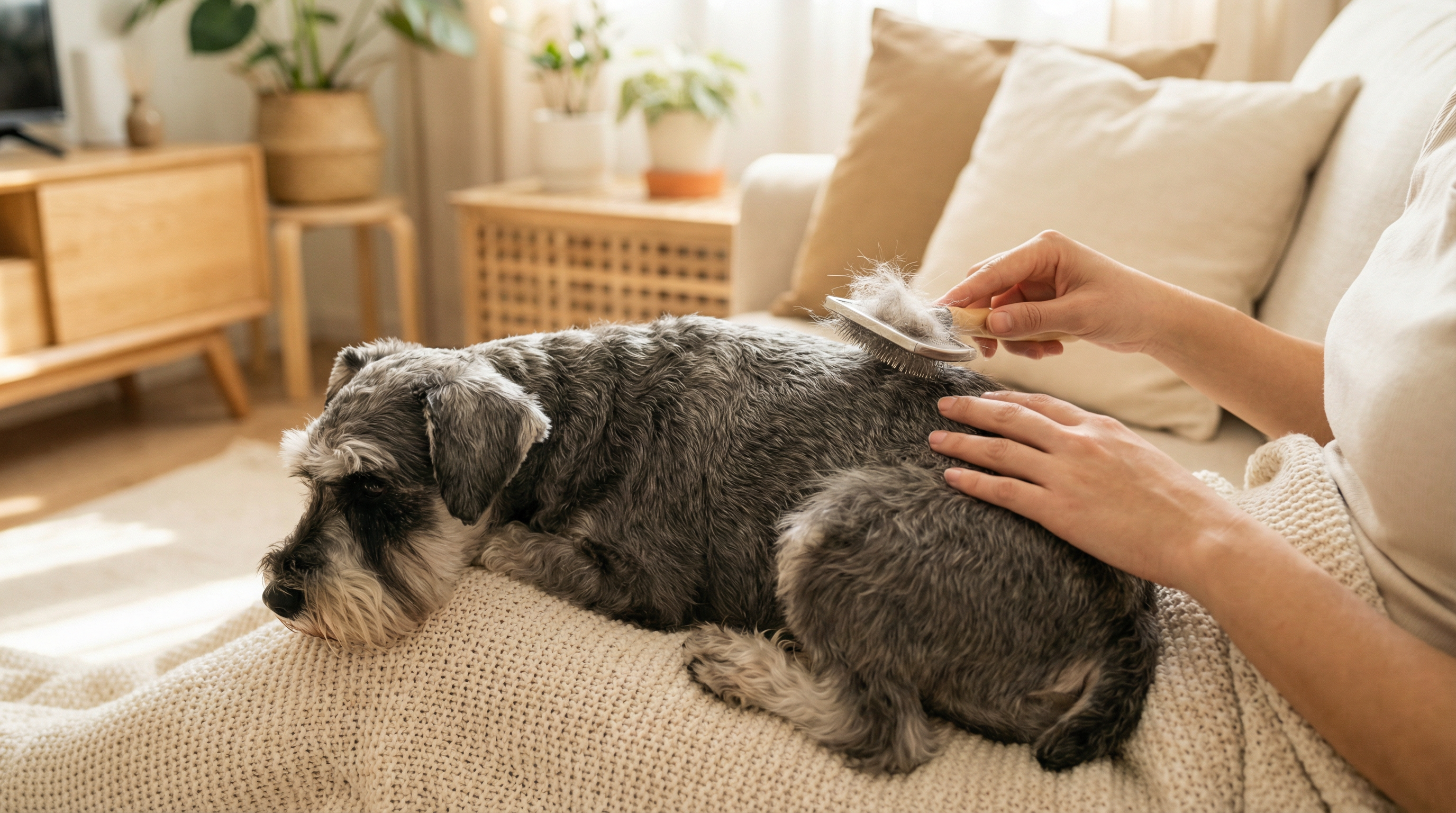
Neither of these breeds is "low maintenance" when it comes to grooming. Both have double coats that require regular attention to prevent matting and maintain their iconic silhouettes.
* Mini Dachshund: They have a wiry outer coat and a soft undercoat. Most owners opt for a "Dachshund cut" every 6 to 8 weeks, which involves clipping the back short and leaving the long "furnishings" on the legs and that signature beard. Weekly brushing is a must, especially for the beard, which can become a magnet for food and debris.
* Scottish Terrier: Their grooming is even more specialized. To maintain the correct wiry texture of a show dog, their coat should be "hand-stripped" (pulling out dead hair by hand). However, most pet owners choose to have them clipped every 2 months. Like the Dachshund, they need frequent brushing to keep their long "skirts" from tangling [3].
Comparison Table: At a Glance
| Feature | Mini Dachshund | Scottish Terrier |
|---|---|---|
| Origin | Germany | Scotland |
| Height | 12–14 inches | 10 inches |
| Weight | 11–20 lbs | 18–22 lbs |
| Temperament | Social, Playful, Alert | Independent, Dignified, Aloof |
| Trainability | High (Eager to please) | Moderate (Independent thinker) |
| Grooming | High (Professional clip/Weekly brush) | High (Stripping or clipping) |
| Exercise | 60+ minutes daily | 45–60 minutes daily |
| Kid-Friendly | Excellent (with socialization) | Better with older children |
| Other Pets | Generally good with other dogs | Can be selective/High prey drive |
| Lifespan | 12–15 years | 12 years |
| Avg. Price | $1,500 – $3,000 | $1,500 – $2,500 |
Health and Longevity
While both breeds are generally sturdy, they each have specific health predispositions that potential owners should be aware of.
Mini Dachshund Health
These dogs are prone to metabolic issues. Pancreatitis is a major concern, often triggered by high-fat foods, so a strict diet is essential. They are also susceptible to "Dachshund bumps" (a type of skin cyst), bladder stones, and certain eye conditions like cataracts. Regular vet check-ups and a high-quality, low-fat diet are the best preventative measures [4].
Scottish Terrier Health
Scotties have a unique condition called "Scottie Cramp," which is a genetic movement disorder that causes the legs to splay or cramp during excitement or exercise. While it looks scary, it isn't usually painful. More seriously, the breed has a significantly higher risk of bladder cancer (Transitional Cell Carcinoma) than other breeds. They can also suffer from Von Willebrand's disease, a blood clotting disorder [5].
Exercise and Living Situations
Both breeds are adaptable and can thrive in apartments or houses, provided their exercise needs are met. The Mini Dachshund is the more active of the two; they have a lot of "bounce" and love a good game of fetch or a long walk. They are also quite vocal watchdogs, which is something to consider if you have thin apartment walls.
The Scottish Terrier is more of a "stroller." They enjoy a steady walk and some time to sniff every single blade of grass, but they don't necessarily need the high-intensity play that a Dachshund does. However, because of their strong hunting instinct, they should never be off-leash in an unfenced area. If a Scottie sees a squirrel, he is gone, and he likely won't come back when called [2].
Family Suitability: Kids and Other Pets
If you have young children, the Mini Dachshund is almost always the better choice. They are generally more patient and enjoy the chaotic energy of kids. Scottish Terriers can be wonderful family dogs, but they often prefer the company of older children who understand how to respect a dog's boundaries. A Scottie may not tolerate "rough housing" as well as a Dachshund [1].
Regarding other pets, Dachshunds usually get along well with other dogs. Scotties, however, can be "scrappy." They don't always play well with others, especially dogs of the same sex, and their high prey drive makes them a risky choice for households with cats or small pocket pets [3].
Which Is Right for You?
Choosing between these two comes down to what you want in a companion:
Choose a Mini Dachshund if:
* You want a "shadow" dog that loves to cuddle.
* You have children or other pets.
* You enjoy training and want a dog that listens.
* You have an active lifestyle and want a playful partner.
Choose a Scottish Terrier if:
* You appreciate a dog with a strong, independent personality.
* You prefer a quieter, more dignified companion.
* You have experience with "stubborn" breeds.
* You want a loyal protector who is content with a more relaxed pace.
Daniella’s Verdict
As a long-time mini dachshund mom, I’ll admit I’m biased. There is nothing quite like the "Dachshund wiggle" when you come home from work. However, I have always admired the stoic beauty and fierce loyalty of the Scottie. If you want a dog that is essentially a small human in a fur coat, go with the Dachshund. If you want a dog that is a true, old-soul companion who respects your space as much as his own, the Scottish Terrier is a magnificent choice.
Whichever you choose, prepare for a lot of beard maintenance and even more love!
References
- 1American Kennel Club: Mini Dachshund Breed Information
- 2American Kennel Club: Scottish Terrier Breed Information
- 3Dogster: Mini Dachshund vs. Scottish Terrier
- 4PetMD: Health Issues in Mini Dachshunds
- 5Scottish Terrier Club of America: Health Concerns
Leashes & Lattes Recommends: Essential Gear for Your Bearded Bestie
To keep your Dachshund or Scottie looking and feeling their best, here are a few products we swear by:
- 1Hertzko Self-Cleaning Slicker Brush
* Pros: Easy to clean, gentle on skin, great for removing mats.
* Cons: Can be a bit bulky for very small puppies.
* Verdict: The gold standard for maintaining those leg furnishings and beards without the struggle.
- 2Pet MD Facial Cleansing Wipes
* Pros: Alcohol-free, helps prevent "beard staining," easy to use after meals.
* Cons: Scent might be strong for some sensitive dogs.
* Verdict: A lifesaver for Dachshund owners who want to keep that white beard actually white.
- 3Kong Classic Dog Toy (Small/Medium)
* Pros: Extremely durable, provides mental stimulation, can be stuffed with treats.
* Cons: Heavy for very small dogs.
* Verdict: Both breeds have strong jaws and high intelligence; a stuffed Kong is the perfect "job" for them.
- 4Pet Magasin Professional Grooming Scissors
* Pros: Rounded tips for safety, sharp blades, ergonomic handle.
* Cons: Requires a steady hand.
* Verdict: Perfect for those quick "eyebrow" or "beard" trims between professional grooming visits.